

Research projects
Continuous quality assurance
Quality assurance does not end with test design – it is reviewed and further developed through ongoing research.
- Construct validation
What exactly do C-tests measure? Which linguistic structures, skills and cognitive processes are reflected in the participants’ answers? - Standard-setting for onSET
Which standard-setting methods are suitable for determining CEFR-aligned cut-off scores in onSET? How meaningful are the values obtained - Psychometric modelling
Which psychometric models are suitable for scaling C-tests? How well do the parameters estimated using different models for items (difficulty) and participants (ability) align? Which models and software packages enable the rapid establishment and expansion of a quality-assured item bank? - Testlet effects in the onSET – fairness and item difficulty
Which factors determine difficulty at the text and gap levels? What influence do testlet effects (dependencies between gaps within a text) have on the determination of reliability and the estimation of individual parameters (general language proficiency) and item parameters (difficulty, discrimination)? - Relationship between onSET and skill-specific language tests
How does the general language proficiency measured by onSET relate to skill-specific sub-proficiencies such as reading, listening, writing and speaking? How reliably can performance on the TestDaF be predicted on the basis of onSET results? - Difficulty of C-Test tasks
What factors determine the difficulty of C-Test tasks, at both the text and gap-fill levels?
The time factor in the construct of C-tests
To what extent does time pressure alter what computer-based C-tests measure, and how does this affect validity, reliability and construct structure across different languages and proficiency levels?
Mobile version of onSET
Does the device used (desktop vs. mobile) influence performance, completion time and perceived usability of a digital C-test, and can we speak of device equivalence?
The results of these studies can be found in academic journals and specialist books. See publications
Differentiation of CEFR levels
The onSET provides a total score as well as a classification according to the CEFR (Common European Framework of Reference for Languages) – at levels A2, B1, B2 or C1 and above.
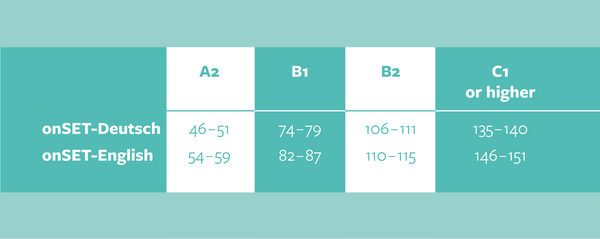
For example
If a test taker receives a B1 result in onSET German with an overall score of 64 points, their performance is in the lower B1 range. This is 10 points below the lower limit of the B1 core range. A score of 87 points, on the other hand, would place their performance in the upper B1 range, 8 points above the upper limit.
Research projects
In its research projects, g.a.s.t. works with partners from academia and practice to explore current questions around language proficiency, academic aptitude and digital learning. Discover our projects, collaborations and research findings.
onSET design
Every onSET task is reviewed by testing experts, linguists and native speakers, and then trialled with large numbers of learners. This produces individual task sets of comparable difficulty, ensuring reliable and fair results.
onSET publications
Explore academic publications on onSET and German-language C-tests, from scaling and standard setting to difficulty prediction and response time.
onSET is an online placement test for German and English based on the C-test format. In just 40 minutes, it provides a reliable assessment of language proficiency from A2 to C1 on the CEFR scale. Universities and language institutes use onSET for course placement, exam readiness, scholarship applications, and proof of language skills for professional purposes.